





















How the Social Health Insurance Fund (SHIF) Affects Payroll in Kenya
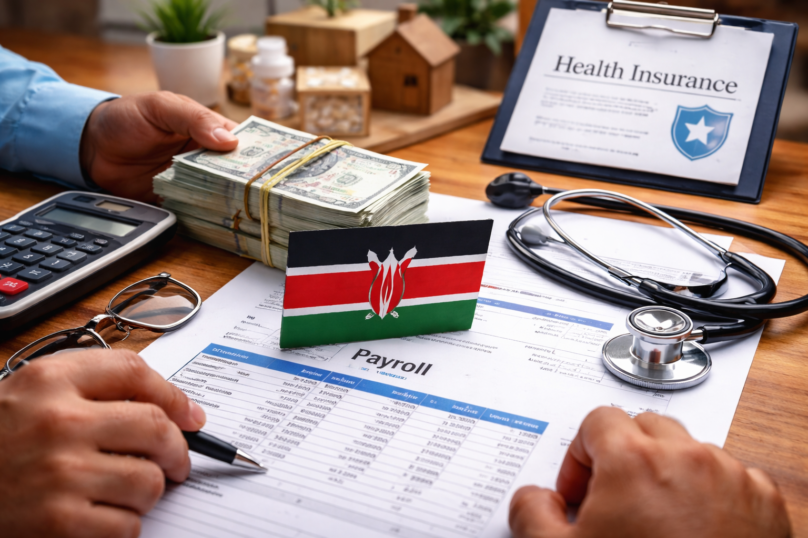
Kenya is evolving rapidly in its approach to citizen welfare and workforce support. Over the past few years, the government has introduced policies aimed at strengthening social protection and improving the quality of life for employed citizens. One of the most significant of these developments is the launch of the Social Health Insurance Fund (SHIF) under the Social Health Insurance Act 2024.
While this reform is designed to enhance healthcare accessibility, it also carries major implications for employers, particularly around payroll compliance. The SHIF introduces mandatory deductions of 2.75% of each employee’s gross monthly salary, with no earnings cap, and establishes criminal penalties for non-compliance.
For any organization, especially foreign-invested enterprises looking to build or expand operations in Kenya, understanding these obligations isn’t optional. Payroll compliance is now a critical pillar of sustainable operations.
In this guide, we’ll explore how SHIF is reshaping Kenya’s payroll framework, what it means for gross salary calculations and statutory deductions, and how global companies can manage these new obligations effectively through strategic planning, automation, and professional partnerships such as Remote Solutions Africa’s Payroll Compliance Service.
The Legislative Shift: From NHIF to the New SHIF Mandate
A. The Legal Foundation
The Social Health Insurance Act 2024 repealed the NHIF Act and introduced the Social Health Insurance Fund (SHIF) to achieve universal health coverage. Unlike the NHIF’s banded model, SHIF applies a flat 2.75% rate on every employee’s total gross salary, broadening coverage but tightening accountability.
Employers must now register all staff with SHIF, deduct contributions monthly, and remit payments to the Social Health Authority. The rule applies equally to Kenyan nationals, expatriates, and contractors — a critical point for foreign businesses operating in Kenya.
B. The Core Calculation: 2.75% of Gross Salary
The 2.75% SHIF contribution applies without an upper limit, marking a major departure from NHIF’s capped structure. The term gross salary includes basic pay, bonuses, commissions, allowances, and mandatory overtime. Misdefining any element here can distort the contribution base and expose the employer to audit risk.
Foreign employers must also consider SHIF in tandem with NSSF Phase 3, which restructured pension contributions. Together, these policies heighten payroll complexity, making automation and local expertise essential.
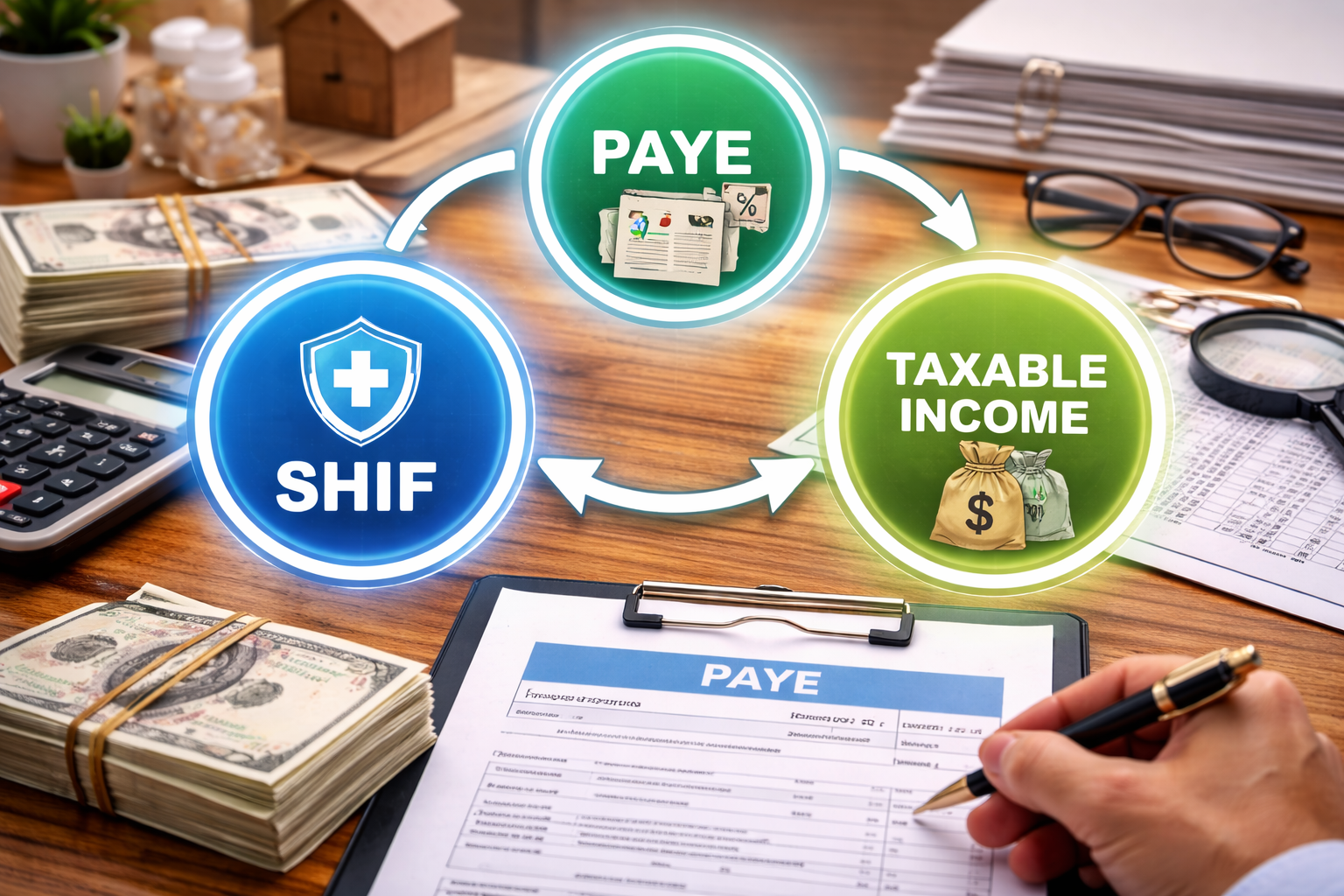
SHIF’s Interconnected Impact on PAYE and Taxable Income
SHIF’s introduction reshapes the tax base and deduction sequence that determine Kenya’s PAYE liability.
A. SHIF as a Tax-Deductible Expense
Under the Tax Laws (Amendment) Act 2024, employee SHIF contributions are tax-deductible, slightly reducing taxable income before PAYE (10%–35%) is applied. Payroll systems must therefore apply SHIF (2.75%) and AHL (1.5%) deductions before computing PAYE. Misordering this sequence can lead to under- or over-payment of tax, both of which attract penalties from the Kenya Revenue Authority (KRA).
B. Integration with the Affordable Housing Levy (AHL)
Because SHIF and AHL both depend on gross monthly salary, accuracy in defining that figure is crucial. AHL contributions are declared within the monthly PAYE return (Form P10, Sheet M), so any discrepancy between payroll and tax filings can cause compliance gaps. Integrated, automated payroll systems, or an experienced EOR partner ensure harmonized calculations and timely submission.
The High-Risk Compliance Profile: Deadlines and Penalties
A. Remittance Deadlines and Financial Penalties
Employers must remit SHIF contributions to the Social Health Authority by the 9th day of the following month. Late remittance attracts a 2% monthly penalty on outstanding amounts, which compounds rapidly and can erode margins for companies managing regional operations.
Automated reminders and centralized treasury controls can prevent oversight, ensuring every deduction is remitted on time.
B. Unique Criminal Liability Risk
Unlike most payroll statutes, SHIF carries criminal enforcement provisions. Employers who fail to remit deductions or make unauthorized withholdings face:
- Fines up to KES 2 million, or
- Imprisonment (up to three years), or both.
This liability extends to company executives and directors, elevating payroll compliance to a governance-level concern. For foreign entities, this underscores the necessity of documented internal controls and trusted in-country payroll partners.

Strategic Mitigation: Ensuring Accuracy and Compliance
A. Automation and Internal Controls
Given SHIF’s interdependence with PAYE, AHL, and NSSF Phase 3, manual payroll processing is no longer sustainable. Robust automation ensures:
- Precise calculation of the 2.75% SHIF and 1.5% AHL deductions.
- Validation of every gross-salary component (allowances, overtime, bonuses).
- Real-time compliance tracking aligned with KRA and Social Health Authority systems.
Automation also creates digital audit trails, an essential safeguard for corporate governance and cross-border reporting.
B. Partnering with an Employer of Record (EOR)
For foreign companies entering or scaling in Kenya, a trusted Employer of Record (EOR) such as Remote Solutions Africa provides a direct compliance advantage.
An EOR:
- Serves as the legal employer for local hires.
- Manages SHIF, PAYE, AHL, and NSSF Phase 3 remittances end-to-end.
- Ensures filings meet SHIF compliance 2025 standards.
- Shields the client organisation from legal and financial liability.
With Remote Solutions Africa’s Payroll Compliance Service, global businesses gain access to localized expertise, advanced payroll systems, and proactive updates on regulatory changes, including evolving Kenya health insurance mandates.
Conclusion: Actionable SHIF Compliance Checklist
Kenya’s move to SHIF represents progress toward universal healthcare, but for employers, it redefines payroll accountability. Ensuring compliance now demands strategic technology investment, strong internal governance, and, for many, collaboration with experienced in-country partners.
SHIF Compliance Checklist
- System Update: Configure payroll software to deduct 2.75% of gross monthly salary for SHIF.
- Gross Pay Integrity: Validate all components, basic pay, bonuses, allowances, to establish the correct deduction base.
- Remittance Discipline: Submit SHIF payments by the 9th day of the following month to avoid 2% penalties.
- Tax Sequencing Accuracy: Apply SHIF and AHL deductions before PAYE computation.
- EOR Partnership: Collaborate with Remote Solutions Africa, your dedicated EOR for Kenya, to safeguard compliance, ensure accurate reporting, and manage SHIF obligations seamlessly.
Meta Description
Kenya’s new Social Health Insurance Fund (SHIF) reshapes payroll compliance for employers. Learn how Remote Solutions Africa’s EOR services help foreign companies manage SHIF deductions, PAYE alignment, and timely remittance, ensuring full compliance and reduced risk in 2025.