
























Mozambique’s 2026 Tax Changes: What International Employers Need to Know Before Hiring

Mozambique tax changes 2026 have raised important questions for international employers hiring, relocating, or managing employees in the country. One major development is the revision of the tax residency criteria, which means employers can no longer rely solely on the number of days an employee spends in Mozambique to assess their tax position.
Law No. 11/2025 of 29 December 2025 amended Mozambique’s Personal Income Tax Code, known locally as the IRPS Code. The amendments took effect on 1 January 2026 and changed the criteria used to determine individual tax residency.
For international companies, NGOs, and development organizations, these changes make it important to review employment arrangements, payroll processes, and employee tax assessments.
This guide explains the key Mozambique tax changes in 2026, how the revised rules affect international employers, and what organizations should review before hiring or relocating employees to the country.
What Changed in Mozambique’s Tax Rules in 2026?
The most significant development for international employers is the revision of the criteria used to determine whether an individual qualifies as a tax resident in Mozambique.
The amendments also address employment income, annual tax returns, digital income, capital gains and rental income.
However, not every change affects ordinary employment payroll in the same way. Employers should identify the provisions relevant to their employees and payment arrangements rather than treating the reform as a single payroll adjustment.
1. The 180-day tax residency criterion was removed
Before 2026, spending more than 180 days in Mozambique was one of the criteria used to establish individual tax residency.
Under Law No. 11/2025, that physical-presence criterion was removed.
The revised framework considers whether an individual has their primary residence in Mozambique, carries out their principal professional activity there, or has their centre of economic interests there. The law also contains specific provisions for certain categories of individuals.
The criteria are explained in PwC’s Mozambique tax residency guidance.
What does this mean for employers?
An employee may potentially qualify as a Mozambican tax resident without spending more than 180 days in the country.
Employers that previously relied mainly on travel-day records should review their approach. Travel records remain useful, but they are no longer sufficient on their own to establish an employee’s tax residency.
2. Employment income and annual tax returns were affected
The amendments repealed provisions that treated tax withheld on employment income as a final tax in the circumstances covered by those provisions. They also changed an exemption from annual income tax filing that applied to certain individuals whose only income was employment income subject to monthly withholding.
However, the position requires an important qualification.
According to PwC’s Mozambique tax administration guidance, individuals whose only income is employment income paid by a Mozambican entity and subject to withholding fall within an exception to the annual filing obligation.
Other employees may have to file annual returns, depending on their circumstances and the applicable rules.
International employers should therefore confirm each employee’s filing obligations rather than assume that monthly payroll withholding resolves every tax responsibility.
3. Further implementing regulations were approved in September 2026
On 29 September 2026, Mozambique’s Council of Ministers approved amendments to the regulations implementing the Personal Income Tax Code.
The government announced the development on its official portal. The announcement described the changes as part of broader efforts to improve the implementation and consistency of the country’s tax legislation.
A report published by Jornal Visão Moçambique also identified several articles of the existing IRPS regulations affected by the amendments.
Government approval, however, does not by itself establish the final publication date or commencement date of a regulatory instrument.
Employers should check the Official Gazette published by Imprensa Nacional de Moçambique for the final decree and verify its effective date before changing payroll processes based on specific provisions.
The underlying amendments introduced by Law No. 11/2025 should be assessed separately from the additional implementing regulations.
Mozambique Tax Residency Rules: Why Counting Days Is No Longer Enough
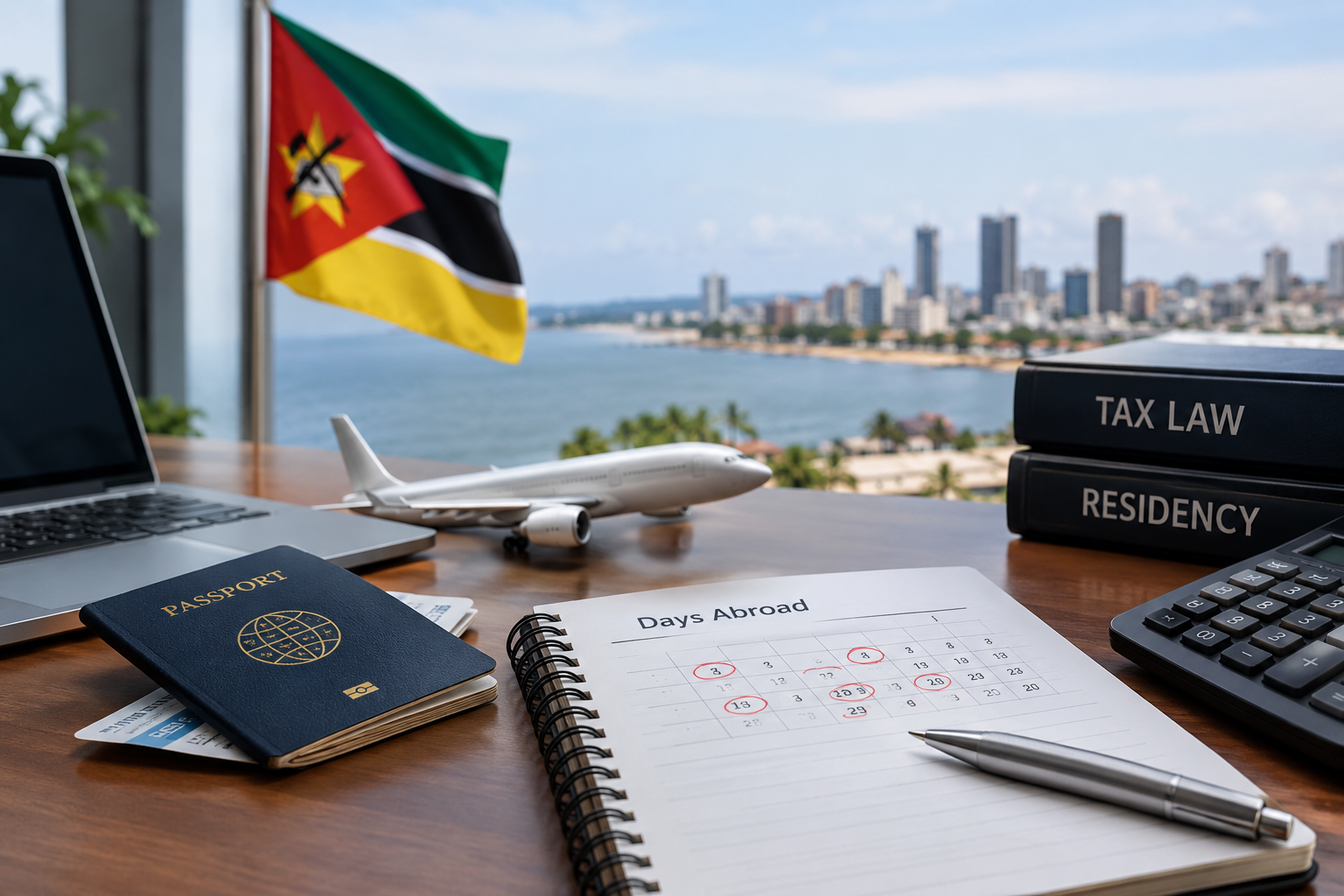
International mobility teams often monitor how long employees spend in different countries to identify potential tax residency issues.
That approach can be useful, particularly when employees travel frequently, work on temporary assignments, or support operations across several markets.
However, Mozambique’s revised rules mean employers need to consider more than the number of days an employee spends in the country.
Which factors matter?
Primary residence: Does the employee maintain their main residence in Mozambique?
Professional activity: Does the employee carry out their professional activity in Mozambique? The revised framework includes remunerated and certain unpaid activities, subject to the applicable exceptions.
Centre of economic interests: Do the individual’s circumstances indicate that their economic interests are centred in Mozambique?
The applicable criteria must be assessed against the facts of the case. Not every person who enters Mozambique becomes a tax resident, and spending fewer than 180 days in the country does not automatically prevent residency.
Employers should consult the applicable legislation and obtain qualified local tax advice where the employee’s circumstances are unclear.
Example: An international NGO relocating a program manager
Imagine an international NGO assigns a program manager to oversee its Mozambique operations.
The manager spends four months in Mozambique and the rest of the year travelling between the organization’s regional office and other project locations.
The NGO assumes that the manager cannot be a Mozambican tax resident because the assignment lasts fewer than 180 days.
That conclusion may be incorrect.
Under the revised framework, the organization needs to consider the manager’s primary residence, professional activity and other relevant circumstances before determining their tax position.
This does not mean that the manager automatically qualifies as a tax resident. It means the organization cannot reach a reliable conclusion from the travel calendar alone.
For NGOs, international development organizations and businesses with mobile workforces, this distinction matters when planning assignments, compensation and payroll arrangements.
The practical lesson is simple: employee mobility records should support a tax assessment, not replace one.
How Mozambique’s 2026 Tax Changes Affect International Employers
The revised rules can affect organizations hiring local professionals, relocating international employees, or managing remote teams.
Hiring local employees
Before making an offer, employers should establish where the employee will perform their duties, which entity will employ them, and what local obligations apply.
This assessment may include:
- Personal income tax withholding.
- Employment registration and statutory reporting.
- Social security registration and contributions.
- Employment contracts and employee documentation.
- Immigration requirements where foreign nationals are involved.
An international organization does not automatically need to establish a subsidiary in every hiring situation. However, it must assess which employment arrangements are legally available and suitable for its activities.
Relocating international employees
Relocation can change an employee’s tax position.
An employee might receive a salary from an overseas employer while performing their duties in Mozambique. They may also receive housing allowances, travel benefits, bonuses or other forms of compensation.
Employers should assess the employee’s tax residency, the source and nature of the income, applicable withholding requirements and any relevant double taxation agreement.
Paying salary from an overseas account does not, by itself, resolve the employee’s Mozambican tax obligations.
A relocation plan should therefore consider tax and payroll requirements before the employee begins working in the country.
Managing remote and cross-border teams
Remote work can make it harder for employers to establish where employees are working and which obligations may arise.
An employee may have an employment contract with an overseas organization but perform their principal professional activity from Mozambique.
Employers should assess the actual working arrangement, not just the location of the contracting entity or the bank account receiving the salary.
They should also consider whether the organization’s activities create separate corporate tax exposure.
Mozambique Payroll Taxes: What Employers Should Review
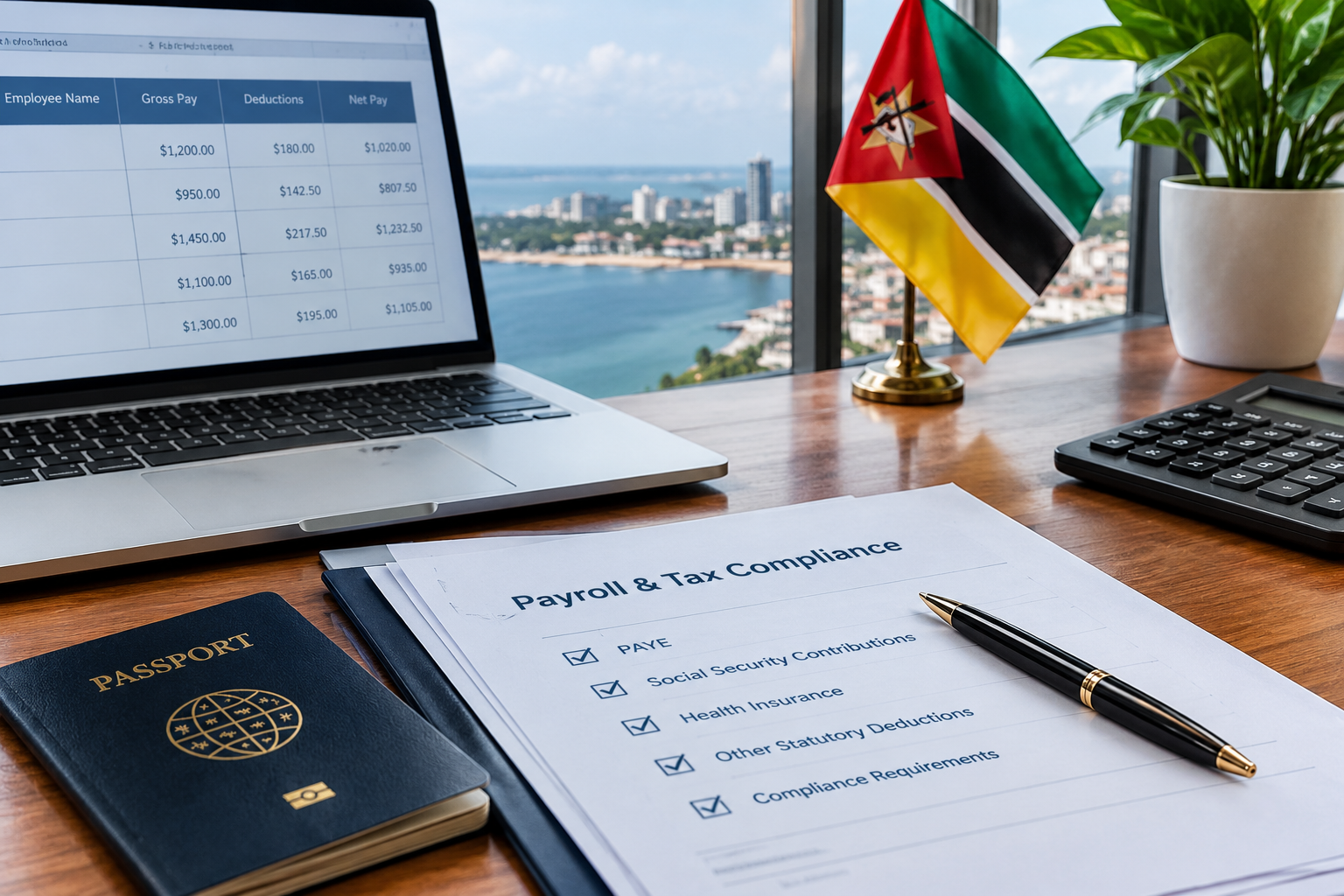
Tax residency is only one part of employment compliance. Employers must also understand the applicable income tax withholding, reporting, payment, and social security requirements.
Personal income tax rates and withholding
Mozambique’s published annual personal income tax schedule for individuals uses progressive rates ranging from 10% to 32%, depending on the taxable income band and applicable deductions.
Non-resident income may be subject to different withholding treatment. PwC’s Mozambique personal income tax guidance identifies a flat 20% rate for the majority of income received by non-residents, although the treatment must be confirmed for the specific payment.
These figures should not be applied mechanically to every employee. The appropriate calculation depends on the individual’s tax status, remuneration, benefits and applicable legal provisions.
Employers should also distinguish between annual tax rates and monthly payroll withholding calculations.
Annual tax returns
Employers should establish whether employees have annual income tax filing obligations under the amended rules.
The answer depends on the employee’s income and payment arrangements. Individuals whose only income is employment income paid by a Mozambican entity and subject to withholding fall within the exception identified in PwC’s tax administration guidance.
Where an employee receives income from multiple sources or is paid through an overseas arrangement, the employer should not assume the same exception applies.
Social security and employment administration
Employers should confirm the applicable social security registration and contribution requirements before hiring.
Employment contracts, employee records, payroll calculations, statutory deductions and payment records should be managed together.
A correct income tax calculation does not, by itself, establish full employment compliance.
What International Employers Should Do Before Hiring in Mozambique
The most effective response to the 2026 tax changes is to review the entire employment arrangement rather than make an isolated payroll adjustment.
Area to review | Recommended action |
Tax residency | Assess the revised criteria rather than relying exclusively on the 180-day threshold. |
Employment structure | Confirm who will legally employ the worker and where the work will be performed. |
Payroll | Review withholding, reporting, payment deadlines, and applicable deductions. |
Annual tax returns | Establish which employees have filing obligations and which exceptions apply. |
Immigration | Confirm the appropriate authorization before a foreign employee begins work. |
Corporate tax | Assess whether the organization’s activities could create a permanent establishment or other local obligations. |
Regulatory updates | Verify the final implementing regulations and their effective dates. |
Assess potential corporate tax exposure.
Personal tax residency and corporate tax exposure are separate issues.
Mozambique’s Law No. 12/2025 also amended its corporate income tax framework. Published guidance identifies changes to permanent establishment rules, including provisions relevant to certain construction, installation and service activities.
See PwC’s Mozambique corporate tax developments.
These rules do not mean that every employee working in Mozambique creates a permanent establishment.
However, organizations with employees delivering services, managing projects or conducting business activities in the country should assess the potential implications with qualified tax advisers.
Monitor the latest implementing regulations.
The government’s September announcement is an important development, but employers should distinguish between the regulations approved by the Council of Ministers and the final published instrument.
Before updating payroll systems or employee policies, verify the decree number, publication date, commencement provisions and any transitional arrangements.
This is particularly important where a change affects reporting procedures, filing deadlines or supporting documentation.
How Remote Solutions Africa Can Help
Hiring in Mozambique involves more than finding the right candidate. Employers must understand how local employment, payroll, tax, and immigration requirements affect their workforce.
Remote Solutions Africa helps international organizations navigate employment and workforce requirements across African markets.
For organizations planning to hire or relocate employees to Mozambique, RSA can support three key areas.
Payroll support
RSA can help organizations understand local payroll requirements and organize the processes needed to manage employee payments and payroll responsibilities.
Tax support
RSA can help businesses identify relevant local tax considerations and understand which requirements need further assessment with qualified local tax professionals.
Immigration assistance
RSA supports organizations navigating immigration requirements for eligible international employees working in African markets.
Where an organization wants to employ staff without immediately establishing its own local entity, an Employer of Record arrangement may also be worth assessing. Its suitability depends on the country’s legal framework, the nature of the work and the organization’s circumstances.
For NGOs and international development organizations, these services can be relevant when recruiting program managers, technical specialists, project staff, and other professionals across borders.
The goal is to help employers understand their options, organize their employment processes, and address local compliance responsibilities before problems arise.
Frequently Asked Questions

What are Mozambique’s main tax changes for 2026?
Law No. 11/2025 amended the Personal Income Tax Code, including the criteria for determining individual tax residency and provisions governing employment income and annual tax returns. The amendments took effect on 1 January 2026.
Can an employee become a Mozambican tax resident without spending 180 days in the country?
Yes, potentially. The revised rules consider factors including primary residence, professional activity, and the center of economic interests. The individual’s circumstances must be assessed against the applicable legal criteria.
Do foreign employers need a local entity to hire in Mozambique?
Not necessarily in every situation. The appropriate arrangement depends on the organization’s activities, the employee’s role, and local legal requirements. Employers should assess whether an Employer of Record or another lawful arrangement is suitable.
Does monthly tax withholding remove the need to file an annual tax return?
Not in every case. The filing obligation depends on the employee’s circumstances. PwC’s guidance identifies an exception for individuals whose only income is employment income paid by a Mozambican entity and subject to withholding.
Can an Employer of Record help with hiring in Mozambique?
An Employer of Record may provide a way to employ staff without establishing a separate local entity where the arrangement is lawful and suitable. Employers should confirm the provider’s capabilities, the scope of its responsibilities, and any obligations that remain with the client organization.
Planning to Hire in Mozambique? Get the Right Support Before Your Next Hire
Mozambique’s 2026 tax changes make one thing clear: international employers should not rely on the 180-day rule alone when assessing employee tax residency.
The revised framework requires greater attention to employees’ residence, professional activities, and economic circumstances. Employers must also understand how payroll, annual filing requirements, immigration and corporate tax considerations fit into their hiring plans.
For organizations recruiting local staff, relocating international employees or managing cross-border projects, reviewing these requirements early can help prevent avoidable compliance problems.
Remote Solutions Africa supports international organizations with payroll, tax support, and immigration assistance across African markets.
Planning to hire in Mozambique or expand your workforce across Africa?
Let us discuss your hiring plans and the support your organization may need.
Email: info@remotesolutionsafrica.com
Website: www.remotesolutionsafrica.com