
























Angola Work Permit for Foreign Workers: A Complete Guide for Foreign Employers
Hiring a foreign employee in Angola involves more than finding the right person and getting them on a plane.
Before an international employee can legally take up employment in Angola, employers need to consider immigration, employment contracts, professional qualifications, document authentication, labor registration and sector-specific requirements. Getting any part of the process wrong can delay mobilization, disrupt a project or create unnecessary compliance exposure.
This is particularly important for businesses operating in sectors such as oil and gas, construction, mining, manufacturing and industrial services, where employees may need to be physically present at a specific project site or offshore facility.
Angola’s current framework for non-resident foreign workers is governed by several pieces of legislation, including the General Labor Law and Presidential Decree No. 49/25 of 18 February 2025, which regulates their professional activities. The 2025 decree replaced the previous 2017 framework.
For employers, the practical lesson is simple: an Angola work visa should be treated as part of a wider employment compliance process, not as a standalone immigration application.
Who Needs an Angola Work Permit?
A foreign national who intends to work in Angola generally needs the appropriate work authorization before carrying out employment activities.
Under Presidential Decree No. 49/25, a non-resident foreign worker must hold a valid work visa for the duration of the employment contract, be of legal working age, have the relevant technical or scientific professional qualifications and provide evidence of physical and mental fitness through a medical certificate issued in the country where the contract is concluded.
The rules apply broadly to employment relationships involving private and public companies, mixed companies, cooperatives, social organizations, international organizations and diplomatic or consular representations, including certain service and technical-assistance arrangements.
This means a foreign employer should not assume that a short-term project, technical assignment or specialist role automatically removes the need to assess work authorization.
Work permit vs. business or tourist travel
One of the most important distinctions for employers is between being allowed to enter Angola and being allowed to work in Angola.
A visa that permits someone to enter the country does not automatically give that person permission to perform employment activities. Angola’s immigration framework specifically provides that a work visa authorizes the holder to perform the professional activity for which it was granted and to work for the employer that requested it.
For example, imagine a UK-based engineering company sends a mechanical engineer to Luanda to support an industrial project.
If the engineer is simply travelling for meetings, the applicable immigration route may differ from a situation where the engineer will physically perform engineering duties at a project site.
That distinction should be established before travel is booked, not after the employee arrives.
Angola Work Permit Requirements for Foreign Employees
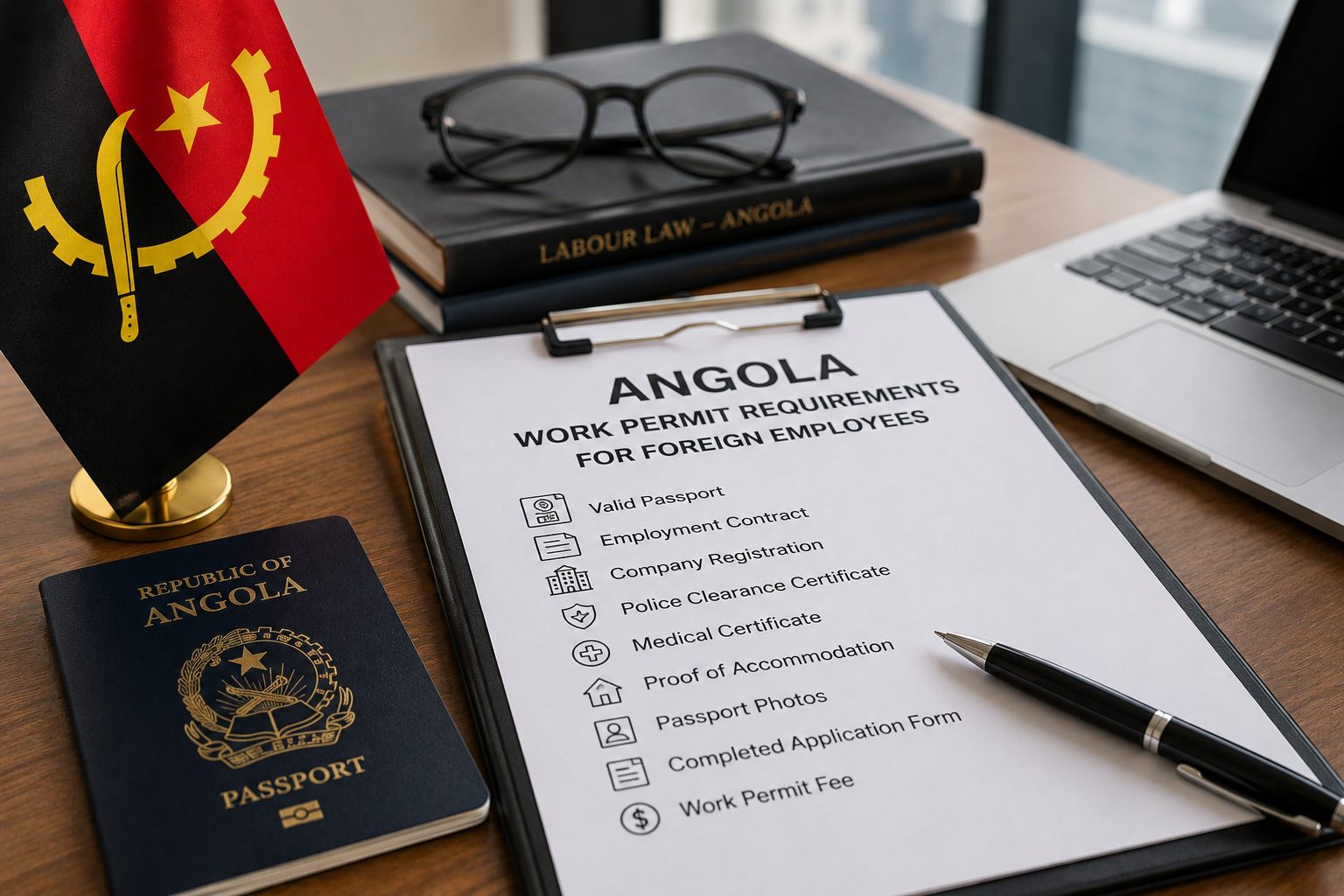
The exact checklist can vary depending on the employee, employer, industry, work location and immigration route. Current Angolan consular guidance lists documents such as the work contract, professional qualifications, medical certificate, criminal record, proof of residence, passport, employer documentation and other supporting documents.
Remote Solutions Africa’s Angola work visa process also highlights the importance of assessing the proposed position, work location, rotation and project before issuing the final document checklist.
A practical employer checklist includes:
Area | Typical information or documents |
Employee identity | Valid passport and photographs |
Employment | Employment contract or assignment documentation |
Role | Job title, detailed responsibilities and professional category |
Qualifications | Academic and professional certificates |
Experience | Curriculum vitae and evidence of relevant experience |
Health | Required medical certificate |
Background | Criminal record or police clearance where required |
Residence | Proof of residence where required |
Employer | Corporate registration and supporting company documents |
Immigration | Visa application forms, letters and supporting declarations |
Travel | Flight reservation or travel information where required |
Health/travel | International vaccination documentation where applicable |
Authentication | Notarization, legalization, authentication and certified Portuguese translation where applicable |
The Angolan Consulate in Johannesburg, for example, lists a work contract, professional qualifications translated into Portuguese, criminal record, medical certificate, employer documents, proof of tax payments, flight reservation and yellow fever vaccination documentation among its requirements.
Why the job itself matters
Employers should prepare more than a job title.
The Angola work visa assessment should clearly establish:
- What the employee will do
- Where the employee will work
- Which project or client they will support
- Which department they belong to
- Which industry they will work in
- Whether the work is onshore or offshore
- Whether they will work on a vessel, platform, plant or restricted facility
- When the project starts
- When the employee must physically arrive in Angola
- Whether the employee will work on a rotation such as 28/28 or 35/35
These details can materially affect the immigration and labor compliance route.
For an oil and gas company, for example, “Project Engineer” is not enough information. The employer should identify the project, location, work pattern and nature of the assignment.
How to Apply for an Angola Work Visa: Step-by-Step
For international employers, the safest approach is to manage the work permit as a coordinated immigration and employment process.
Step 1: Assess eligibility and the assignment
Start by reviewing the employee’s qualifications, professional experience, proposed role, employer structure and intended work arrangement.
This determines which requirements apply and whether additional labor or sector-specific considerations need to be addressed.
Step 2: Check the employer’s compliance position
The sponsoring employer needs to have the appropriate corporate and regulatory documentation.
Depending on the situation, this can include corporate, tax, social security, labor and sector-specific registrations. Gaps in these areas can create problems later in the immigration process.
This is one reason foreign employers often work with an EOR or local workforce partner rather than trying to coordinate every requirement from outside Angola.
Step 3: Build the case-specific document checklist
There is no sensible one-size-fits-all checklist for every foreign employee.
The documentation should be separated into:
- Employee documents
- Employer documents
- Employment and assignment documents
- Sector-specific documents
- Documents requiring notarization, legalization, authentication or certified translation.
Step 4: Authenticate and translate documents
Foreign-issued documents may need authentication, legalization or notarization and may need certified translation into Portuguese before submission.
This is an area where employers often lose time.
A qualification may be genuine and valid, but if it has not been prepared in the format required by the relevant authority, the application can still face delays.
Step 5: Prepare the employment and sponsorship documents
The employment contract, assignment documentation, employer request letter, professional justification and supporting declarations should tell the same story.
The role described in the employment contract should match the immigration application.
The employer should also consider the requirements applicable to foreign-worker contracts under Presidential Decree No. 49/25. The decree requires a written contract containing details such as the parties, professional category, work location, working hours, remuneration, start date and a commitment by the worker to return to their country of origin after the contract ends.
Step 6: Submit the visa application
Once the application file is complete, it can be submitted through the competent Angolan diplomatic or consular authority, with the process coordinated with the relevant stakeholders.
Current Angolan consular guidance also indicates that applications may require the applicant’s presence when submitting the file, depending on the applicable process.
Step 7: Complete post-approval employment compliance
Getting the visa is not necessarily the final step.
Under the 2025 foreign-worker rules, contracts and their renewals or addenda are subject to registration. The employer must submit the relevant registration request to the employment center for the company’s area within 30 days after the worker begins professional activity.
For employers, this is a crucial point: immigration compliance and employment compliance need to be managed together.

Angola Work Permit Processing Time and Timeline
Employers should plan the Angola work permit process around the project mobilization date, rather than starting when the employee is ready to fly.
Remote Solutions Africa’s process document estimates a processing timeline of 6–8 weeks, starting once the required documentation and confirmations have been received.
However, this should be treated as a planning estimate rather than a guaranteed government processing time.
The actual timeline can be affected by:
- Availability and validity of employer documents
- Time required to obtain police, medical, academic and professional documents
- Authentication and translation requirements
- Location of the relevant Angolan consulate
- Processing time of the competent authorities
- Additional approvals required for the employee’s sector or work location.
A better way to plan
If an international company needs an engineer in Angola on 1 November, it should not begin the immigration process in late October.
A better planning sequence is:
Project confirmation → role assessment → employer compliance check → document collection → authentication/translation → application → approval → travel → onboarding → employment registration
This gives the employer room to deal with missing documents or additional requirements without putting the project start date at risk.
COST: The cost of employing a foreign worker in Angola depends on the specific case and the services included.
Visa fee includes items such as government fees, invitation letter, translations where applicable, notarization/legalization where applicable, immigration notifications, relevant stamps, application preparation, submission support, collection/drop-off, courier costs where applicable, sponsored employment and registration with local tax and social security authorities.
Common Angola Work Permit Mistakes and How an EOR Can Help
The most expensive work permit problems are often not caused by the visa application itself. They happen because employers start the process too late or treat immigration as an isolated HR task.
Here are some of the mistakes we see employers need to avoid.
Starting after the project deadline is fixed.
A 6–8 week planning estimate can disappear quickly once you add document collection, authentication, and translation.
Using a generic document checklist.
The requirements can depend on the employee’s role, sector, location and assignment. A specialist working offshore may have a very different compliance profile from an employee based in an office.
Ignoring the employer’s own compliance position.
The employee may have every required document, but the sponsoring employer can still have outstanding corporate, labor, tax or social security requirements.
Assuming visa approval ends the process.
Employment contract registration and other post-arrival obligations still need attention.
Booking travel before confirming the immigration route.
An employee arriving in Angola does not automatically mean they have permission to work.
Failing to plan for Portuguese documentation.
Foreign documents may require certified translation and authentication. This should happen early, not when the application is ready for submission.
For companies without an established Angolan entity or HR infrastructure, an Employer of Record can provide a practical alternative.
Instead of establishing a local entity before making the hire, an EOR can act as the local employer and manage employment contracts, onboarding, payroll, statutory compliance and immigration support, depending on the structure of the engagement.
Remote Solutions Africa provides EOR, payroll outsourcing, immigration and work permit, and recruitment, health insurance, and entity support services for organizations expanding across Africa.
This can be particularly useful when a company wants to:
- Hire one or a small number of employees in Angola
- Mobilize specialist talent for a project
- Test the Angolan market before establishing an entity
- Support an NGO or development program
- Bring technical specialists into an oil, gas, construction, mining or industrial project
- Centralize payroll and employment administration while managing the employee’s day-to-day work directly
The key is to start with the employment structure and immigration assessment, rather than simply asking, “How quickly can we get the visa?”
CONCLUSION
Hiring foreign talent in Angola is entirely possible, but employers need to look beyond the visa application.
The strongest approach connects work authorization, employment contracts, employer compliance, document authentication, labor registration, payroll and project mobilization into one process.
For a foreign employer, the goal should not simply be to get an employee into Angola. It should be to get them there legally, on time and under the right employment structure.
Angola’s current rules, particularly the 2025 framework for non-resident foreign workers, make early planning even more important. The 30% foreign-worker limit, contract requirements, registration obligations and 5% contract-registration fee can all affect the cost and structure of an international hiring plan.
If you are hiring a foreign employee in Angola and do not have the local HR or immigration infrastructure to manage the process yourself, Remote Solutions Africa can help.
From work permit and immigration support to Employer of Record services, onboarding, payroll and local employment compliance, we help international organizations build and manage teams across Africa without having to navigate every local requirement alone.
Planning to hire or mobilize employees in Angola?
Talk to Remote Solutions Africa about your Angola hiring and work permit requirements